· VizSeek · Blog · 2 min read
Why Engineering Data Gets Lost in Manufacturing
Engineering files are often spread across systems, folders, people, and old projects. That makes valuable knowledge hard to discover when teams need it.
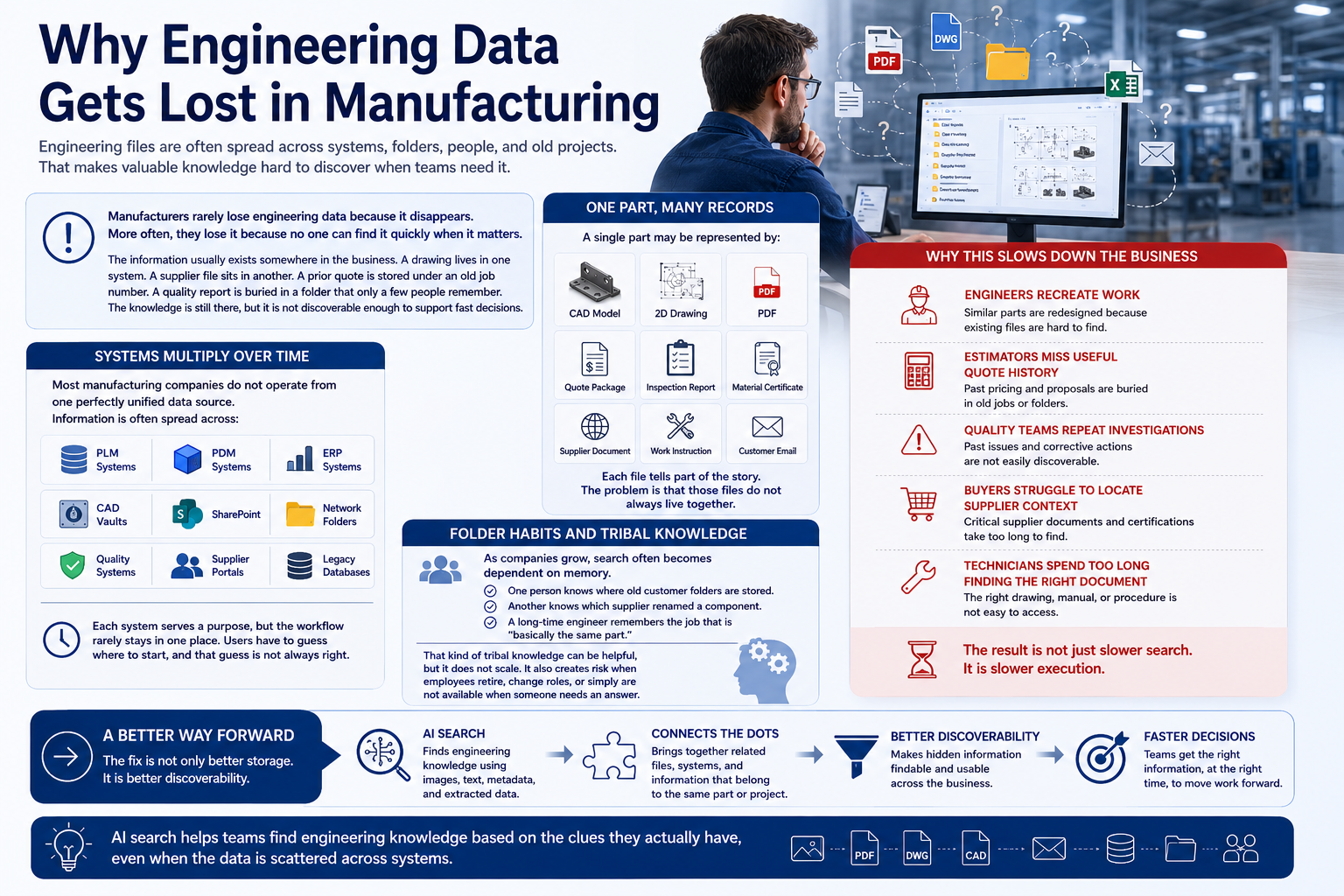
Manufacturers rarely lose engineering data because it disappears. More often, they lose it because no one can find it quickly when it matters.
The information usually exists somewhere in the business. A drawing lives in one system. A supplier file sits in another. A prior quote is stored under an old job number. A quality report is buried in a folder that only a few people remember.
That is what makes the problem so frustrating. The knowledge is still there, but it is not discoverable enough to support fast decisions.
One Part, Many Records
A single part may be represented by:
- a CAD model
- a 2D drawing
- a PDF
- a quote package
- an inspection report
- a material certificate
- a supplier document
- a work instruction
- a customer email
Each file tells part of the story. The problem is that those files do not always live together.
Systems Multiply Over Time
Most manufacturing companies do not operate from one perfectly unified data source.
Information is often spread across:
- PLM systems
- PDM systems
- ERP systems
- CAD vaults
- SharePoint
- network folders
- quality systems
- supplier portals
- legacy databases
Each system serves a purpose, but the workflow rarely stays in one place. Users have to guess where to start, and that guess is not always right.
Folder Habits and Tribal Knowledge
As companies grow, search often becomes dependent on memory.
One person knows where old customer folders are stored. Another knows which supplier renamed a component. A long-time engineer remembers the job that is “basically the same part.”
That kind of tribal knowledge can be helpful, but it does not scale. It also creates risk when employees retire, change roles, or simply are not available when someone needs an answer.
Why This Slows Down the Business
When engineering data is hard to find, the impact shows up everywhere:
- engineers recreate work
- estimators miss useful quote history
- quality teams repeat investigations
- buyers struggle to locate supplier context
- technicians spend too long finding the right document
The result is not just slower search. It is slower execution.
A Better Way Forward
The fix is not only better storage. It is better discoverability.
That is why AI search matters. It helps teams find engineering knowledge based on the clues they actually have, even when the data is scattered across systems.
If you want the broader overview, start here: The Hidden Cost of Lost Engineering Data.