
Overview
Starting investigations with what teams can see
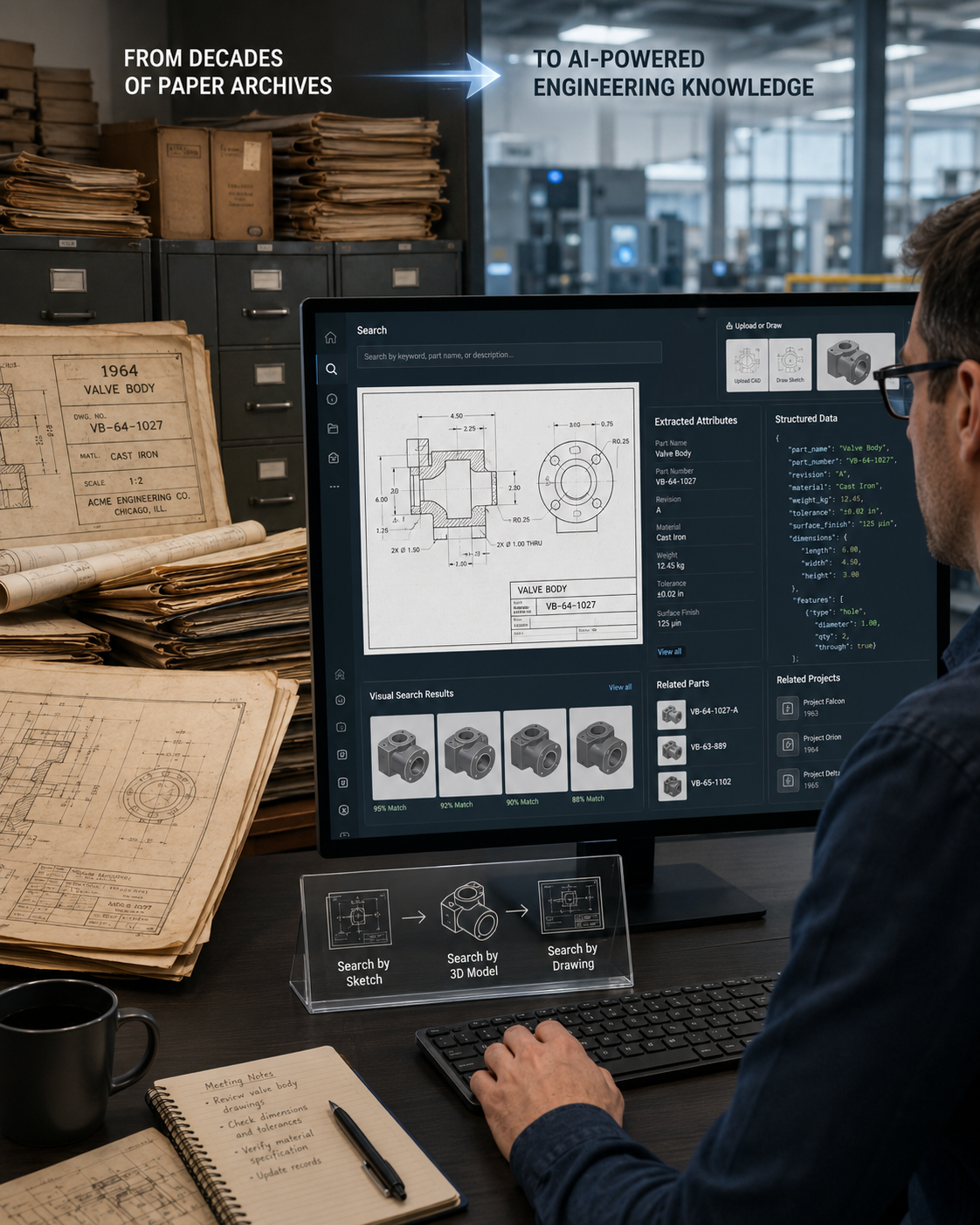
For decades, the company relied on physical blueprint drawings and technical documents as the source of truth for historical manufacturing knowledge. These documents included part details, title block information, tolerances, PMI, material specifications, dimensions, and other critical engineering data.
Although the drawings were valuable, they were difficult to access. Engineers often had to manually search through cabinets, folders, and archived records to locate a specific drawing or determine whether a similar part or project had already been created.
The company first digitized the legacy drawings, creating image-based and document-based files that could be processed by VizSeek. Once digitized, the drawings were fed into the VizSeek AI engine, where key attributes, shapes, tolerances, PMI, title block fields, and manufacturing details were extracted and indexed.
VizSeek converted the previously hidden engineering knowledge into rich searchable data. Engineers could now search using text, questions, images, CAD sketches, 3D models, or visual examples to find the same or similar parts, drawings, and projects.
The extracted content was also output in a structured format, such as JSON, allowing the company to import the data into its PLM system. This created a searchable bridge between decades of legacy engineering documentation and the company’s modern digital workflow.
The Challenge
The challenge
The company had thousands of old blueprint drawings and technical documents dating back to the 1960s. Many drawings were stored in physical file cabinets and were not consistently organized. Important manufacturing information was locked inside paper drawings and scanned documents. Engineers could spend hours or days searching for the correct drawing. Historical project knowledge was difficult to reuse in new designs. Similar parts and past projects were often missed because they could not be found visually. Title block data, tolerances, PMI, dimensions, and material details were not easily searchable. 3D models and CAD references could not easily be matched against older drawings and archived projects. The company needed a way to connect legacy drawing data to its modern PLM system.
Needed Capabilities
- Digitize and process legacy blueprint drawings.
- Extract title block information from old engineering drawings.
- Identify PMI, tolerances, dimensions, materials, part descriptions, and other drawing attributes.
- Recognize visual shapes and geometric similarities across drawings.
- Support search using CAD sketches, images, visual examples, and 3D models.
- Search by text, image, CAD sketch, 3D model, part information, or natural language question.
- Return same or similar drawings, parts, and projects based on visual or 3D input.
- Output extracted engineering data in a structured format such as JSON.
- Import extracted drawing data into a PLM system.
- Make historical manufacturing knowledge searchable across teams.
- Reduce time spent manually searching through file cabinets and archives.
The Solution
The solution
The company began by digitizing its legacy blueprint drawings and technical documents. This converted the physical archive into digital files that could be processed and indexed by VizSeek.
Once digitized, the drawings were uploaded into the VizSeek AI engine. VizSeek analyzed the drawings to extract title block data, PMI, tolerances, dimensions, materials, part descriptions, drawing numbers, and other manufacturing attributes.
VizSeek also analyzed the visual characteristics of the drawings, including shapes, geometry, and layout. This allowed the company to search not only by text or metadata, but also by visual similarity.
The company could also use CAD sketches and 3D models as search inputs to locate same or similar parts, drawings, and previous projects. This made it easier for engineers to find relevant legacy information even when they did not know the original drawing number, project name, or part description.
The extracted content was organized into structured data, including JSON output. This gave the company a clean format that could be imported into its PLM system and connected to existing engineering records.
After implementation, engineers could upload a CAD sketch, 3D model, drawing image, or other visual input to find similar parts and past projects. They could also ask text-based questions and receive answers based on information extracted from the digitized drawings and documents.
Instead of manually searching through file cabinets, engineers could quickly locate useful historical designs, reuse previous project knowledge, and make better-informed design decisions.
Visual conditions
Old scanned blueprint drawings with varying quality.
Hand-marked or aged technical documents.
Legacy title blocks with inconsistent formatting.
Engineering drawings dating back to the 1960s.
Mixed drawing styles across decades of projects.
Blueprints containing dimensions, tolerances, PMI, and material notes.
Drawings with similar shapes but different part numbers or project names.
CAD sketches used as visual search inputs.
3D models used as similarity search inputs.
Scanned documents and drawings connected to PLM records.
Workflow
How it worked in practice
The company digitized its physical archive of blueprint drawings and technical documents. Digitized drawings were uploaded into the VizSeek AI engine. VizSeek extracted title block data, PMI, tolerances, dimensions, materials, part descriptions, and other attributes. VizSeek indexed visual features, shapes, and drawing geometry for similarity search. CAD sketches and 3D models were used as search inputs to locate same or similar parts and projects. Extracted content was output in a structured format such as JSON. The structured data was imported into the company’s PLM system. Engineers searched using CAD sketches, 3D models, scanned drawings, part information, or natural language questions. VizSeek returned same or similar drawings, related projects, and extracted engineering information. Engineering teams reused previous designs and manufacturing knowledge in new projects.
01
Legacy blueprint drawings.
02
Technical documents.
03
Scanned drawing files.
04
Title block information.
05
PMI and tolerance data.
06
Material specifications.
07
Part descriptions.
08
Dimensions and drawing notes.
09
Geometric shapes and visual features.
10
3D model geometry.
11
Structured JSON output.
12
PLM system records.
13
CAD sketch search inputs.
14
3D model search inputs.
15
Natural language engineering questions.
Results
Results
Engineering teams gained fast access to decades of legacy drawing data. Search time was reduced from hours or days to minutes. Historical manufacturing knowledge became searchable by text, visual input, and 3D model input. Engineers could find similar projects and reuse previous design work. Extracted drawing data was imported into the company’s PLM system. The company improved productivity by reducing manual document searches. Design teams made better use of existing engineering knowledge. The business increased profitability by saving engineering time and reducing duplicate work.
- OK Reduced time spent locating old drawings.
- OK Improved reuse of historical engineering projects.
- OK Better access to manufacturing information stored in legacy documents.
- OK More complete PLM records using extracted structured data.
- OK Searchable title block, PMI, tolerance, material, and dimension data.
- OK Visual search for same or similar parts and projects.
- OK 3D model search for related legacy drawings and designs.
- OK Natural language access to drawing and document content.
- OK Higher engineering productivity.
- OK Reduced duplicate design effort.
- OK Improved profitability through faster project execution.
Why It Mattered
Why it mattered
The company’s historical drawings represented decades of valuable engineering and manufacturing knowledge. Before VizSeek, that knowledge was difficult to access because it was trapped in physical files and unstructured documents.
By digitizing the drawings and using VizSeek to extract and structure the data, the company turned its legacy archive into a modern engineering knowledge base.
This allowed engineers to search the archive the way they actually work: by sketch, 3D model, visual example, part similarity, metadata, or question. Instead of starting from scratch, teams could find and reuse proven designs from previous projects.
Connecting the extracted data to the company’s PLM system also made the information more useful across the organization. Legacy drawings were no longer isolated records; they became searchable, reusable engineering assets.
Conclusion
Conclusion
VizSeek helped the engineering company transform thousands of legacy blueprint drawings and technical documents into searchable, structured, reusable engineering data. By combining digitization, AI extraction, visual search, 3D model search, text search, and PLM integration, the company unlocked decades of historical manufacturing knowledge. What was once buried in file cabinets became a searchable digital resource that engineers could use to find similar parts, answer technical questions, reuse previous projects, and make faster design decisions. The result was a more productive engineering workflow, reduced search time, better design reuse, and improved profitability.